

Quick Answer
Egg freezing, medically termed oocyte cryopreservation, is a medical process where a woman's eggs are collected, frozen at ultra-low temperatures, and stored for future use. It helps preserve egg quality at a younger age, not increase egg count, allowing women to use these eggs later for pregnancy through in vitro fertilization (IVF). Egg freezing does not guarantee pregnancy, but it increases future reproductive options by preserving eggs before age-related quality decline occurs. At Proactive For Her, egg freezing counseling focuses on helping women understand whether this option aligns with their life plans and reproductive goals.
What Does Egg Freezing Actually Mean?
Egg freezing preserves unfertilized eggs in their current state through vitrification, a rapid freezing technique that prevents ice crystal formation that could damage cellular structures. The process stops biological aging of those specific eggs, the eggs you freeze at age 30 remain biologically 30 even if you use them at age 40.
The critical distinction is between eggs now versus eggs later. Your eggs at 28 have significantly better quality than your eggs at 38 due to age-related chromosomal changes, reduced cellular energy, and accumulated oxidative damage. Egg freezing captures your eggs at their current quality before further decline occurs.
Why age matters more than lifestyle relates to fundamental reproductive biology. While nutrition, stress management, and avoiding toxins support egg health, they cannot prevent age-related quality decline. A healthy 38-year-old has older eggs than a less healthy 28-year-old, age is the dominant factor in egg quality regardless of lifestyle optimization.
Egg freezing is often misunderstood as a fertility "treatment" addressing current fertility problems. It's not, it's fertility preservation addressing future fertility timeline concerns. Women who freeze eggs typically have normal current fertility but want to preserve options before age-related decline reduces those options.
Why Do Women Choose to Freeze Their Eggs?
Women choose egg freezing for diverse personal, professional, and medical reasons, all valid planning decisions rather than emergency responses.
Not ready for children yet represents the most common reason. Career goals requiring focus and time, financial stability building before parenting, personal development priorities, or desire for specific life experiences before parenthood all influence reproductive timing. Egg freezing allows pursuing these goals while preserving fertility options.
No suitable partner doesn't mean desperately searching, it means thoughtfully waiting for the right relationship rather than rushing partnership decisions due to biological pressure. Egg freezing removes the urgency that can lead to poor relationship choices motivated by fertility concerns.
Career or personal goals include demanding professional paths with limited flexibility during prime fertility years, education or training extending into late 20s or 30s, entrepreneurship or business building, or international opportunities best pursued before family responsibilities. These aren't "delays", they're intentional life sequencing where egg freezing provides reproductive flexibility.
Medical reasons include cancer treatment that may affect fertility, medical conditions requiring fertility-impacting medications, genetic factors affecting age of menopause, or planned surgeries potentially impacting ovarian function. Medical egg freezing often occurs younger than elective freezing.
These are proactive planning decisions, not fertility emergencies. Normalizing elective egg freezing as thoughtful reproductive planning, similar to career planning or financial planning, removes unnecessary stigma around choosing optimal timing for major life decisions.
The Egg Freezing Process: What Actually Happens
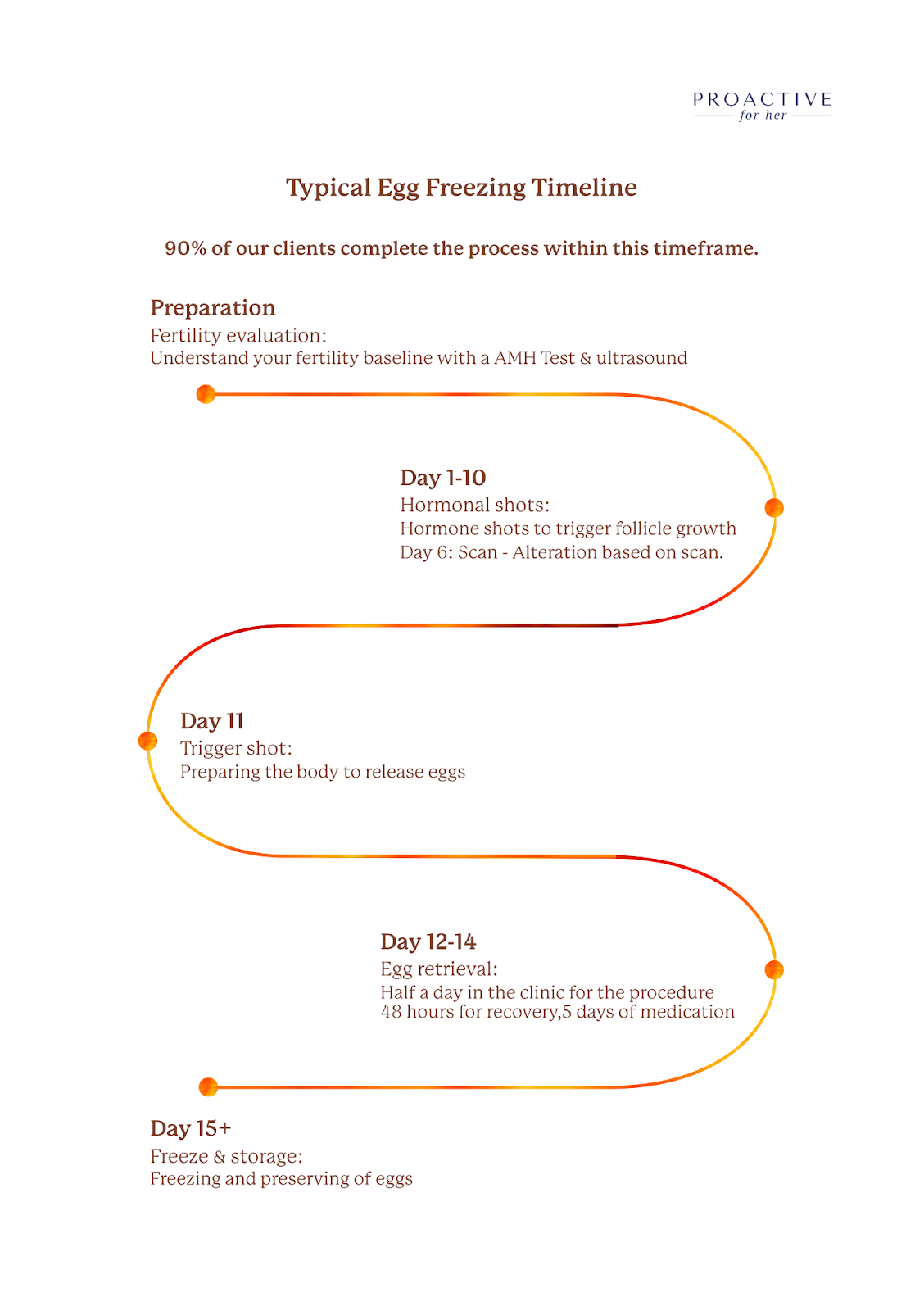
Understanding the process reduces anxiety created by uncertainty about what egg freezing involves.
Initial consultation and testing includes comprehensive discussion of reproductive goals and timeline, ovarian reserve assessment through AMH blood test and antral follicle count ultrasound, medical history review, and realistic outcome prediction based on age and reserve. This consultation at facilities like Proactive For Her focuses on whether egg freezing aligns with individual circumstances rather than universal recommendations.
Ovarian stimulation involves 10-14 days of self-administered hormone injections that stimulate multiple eggs to mature simultaneously (versus the single egg that naturally matures each cycle). Regular monitoring through blood tests and ultrasounds tracks follicle development and timing. This phase requires flexibility for monitoring appointments but doesn't typically require time off work.
Egg retrieval is a minor surgical procedure performed under sedation where mature eggs are collected from ovaries using ultrasound-guided needle aspiration. The procedure takes 15-30 minutes, with recovery typically a few hours. Most women return to normal activities the next day, though some experience temporary bloating or cramping.
Freezing and storage uses vitrification to instantly freeze eggs, preventing ice crystal formation. Frozen eggs are stored in liquid nitrogen at -196°C, where they remain stable indefinitely, eggs frozen for 10+ years show similar viability to recently frozen eggs.
Process anxiety often stems from lack of clarity about what actually happens versus imagined scenarios. Standard medical protocols ensure safety through careful monitoring, controlled medication dosing, and experienced physicians performing retrievals. At Proactive For Her, process transparency includes clear explanation of each step before beginning cycles.
At What Age Is Egg Freezing Most Effective?
Age significantly impacts egg freezing outcomes, though no absolute cut-offs determine candidacy.
Ideal age range generally falls between late 20s and early-to-mid 30s when egg quality remains high, quantity is typically adequate for good retrieval numbers, and frozen eggs have strong post-thaw survival and developmental potential. Freezing at 28-32 provides excellent quality preservation, though earlier or slightly later also works well.
Why earlier eggs have better quality relates to chromosomal integrity. Younger eggs have dramatically lower rates of chromosomal abnormalities (aneuploidy), better cellular energy and function, higher fertilization and development rates, and superior pregnancy rates per egg when eventually used. A woman freezing eggs at 30 versus 38 freezes fundamentally different qualities regardless of quantity retrieved.
Why women still freeze eggs in their late 30s reflects that some fertility preservation is better than none. While optimal timing is earlier, women in their late 30s benefit from freezing current eggs before further decline occurs. More eggs may need freezing to achieve similar future success rates compared to younger ages, but the option remains valuable. Success rates decline with age, but don't drop to zero, individual circumstances and goals determine whether late 30s egg freezing makes sense.
Age-related anxiety is common, but age shaming is unhelpful. The best time to freeze eggs is when you're ready to make that decision with full information about age-specific implications. At Proactive For Her, egg freezing consultations include age-specific outcome predictions without judgment about when women "should have" frozen eggs.
What Egg Freezing Can and Cannot Do
Realistic expectations prevent disappointment and enable informed decision-making.
What egg freezing can do:
- Preserve egg quality at the age when frozen, preventing further age-related decline of those specific eggs
- Increase future reproductive options by providing a "younger egg" backup plan
- Remove time pressure from major life decisions like partnership or career choices
- Provide peace of mind about having taken proactive steps toward future fertility goals
What egg freezing cannot do:
- Stop aging of eggs remaining in your ovaries (only the frozen eggs are preserved)
- Guarantee pregnancy, success depends on egg quality, quantity frozen, fertilization, embryo development, and uterine receptivity
- Replace medical care later, age-related pregnancy complications still apply even with younger eggs
- Extend fertility indefinitely, using frozen eggs still requires functional uterus and overall health supporting pregnancy
Unrealistic expectations cause regret more than egg freezing itself. Women who understand egg freezing as option-expanding rather than pregnancy-guaranteeing make better-informed decisions aligned with actual capabilities and limitations of the technology.
Is Egg Freezing Safe?
Safety considerations include both the egg freezing process itself and long-term outcomes for women and potential future children.
Ovarian stimulation safety has been extensively studied through decades of IVF practice. Hormone medications used are the same as those for IVF, with well-documented safety profiles. The main risk is ovarian hyperstimulation syndrome (OHSS), which careful monitoring largely prevents, severe OHSS occurs in less than 2% of cycles with proper protocols.
Egg retrieval safety involves standard surgical risks of any minor procedure under sedation, infection, bleeding, or organ injury are rare complications occurring in less than 1% of retrievals. The procedure's minimally invasive nature and ultrasound guidance minimize these already-low risks.
Long-term outcomes show no increased cancer risk from egg freezing medications based on extensive follow-up studies, no fertility reduction from the process, remaining eggs continue functioning normally, and no negative impact on future natural fertility or pregnancy outcomes.
Children born from frozen eggs show similar health outcomes to those from fresh eggs or natural conception. Concerns about developmental effects have not materialized in outcome tracking.
Safety concerns legitimately stop some women from exploring egg freezing further. Contextualizing risks, comparing them to other medical procedures or natural pregnancy risks, helps assess whether concerns outweigh potential benefits for individual circumstances.
Egg Freezing in India: What You Need to Know
Egg freezing in India has evolved from experimental to established reproductive medicine practice available in major urban centres.
Availability in metropolitan areas like Bangalore, Mumbai, Delhi, and Chennai includes numerous fertility clinics offering egg freezing with experienced reproductive endocrinologists, modern laboratory facilities with vitrification capability, and comprehensive fertility preservation programs. Proactive For Her operates seven Bangalore clinics providing egg freezing as part of broader women's reproductive health services.
Regulation and medical oversight falls under the Assisted Reproductive Technology (ART) Regulation Act ensuring facilities meet infrastructure standards, physicians have appropriate qualifications, and laboratories maintain quality control. This regulatory framework protects patients through mandatory standards.
Cultural context and stigma creates unique considerations in India where discussing egg freezing may feel uncomfortable due to privacy concerns around reproductive decisions, family pressure regarding marriage and childbearing timelines, or limited awareness about fertility preservation options. Confidential counseling addresses these concerns while respecting individual circumstances and cultural contexts.
Many Indian women don't realize egg freezing is widely available domestically rather than requiring international travel. Established fertility preservation programs exist within India's major cities, making this option more accessible than commonly believed.
Who Should Consider Egg Freezing?
Egg freezing makes sense for some women but isn't universally necessary or beneficial.
Women planning ahead who anticipate not having children in the next 5+ years and are currently in their late 20s or early 30s may benefit from freezing eggs while quality is optimal. This provides backup options if circumstances change or natural fertility declines unexpectedly.
Women unsure about timelines without clear personal or professional plans around childbearing may value the flexibility egg freezing provides. Uncertainty itself can be a valid reason to preserve options.
Women wanting options, not certainty who understand egg freezing as possibility-expanding rather than pregnancy-guaranteeing make suitable candidates. Those seeking guarantees will likely experience disappointment.
Women who should perhaps wait include those actively trying to conceive or planning to within 1-2 years (natural fertility may still work), facing immediate financial constraints making egg freezing impractical, or those who need emergency medical treatment making fertility preservation necessary but requiring expedited protocols.
Egg freezing is about choice and planning, not fear or urgency. Not everyone needs it, that's completely acceptable. Informed decisions respect individual circumstances, values, and goals rather than applying universal recommendations.
Why choose Proactive For Her for Egg Freezing
Proactive For Her provides egg freezing as part of comprehensive women's reproductive, sexual, and mental health services across seven Bangalore locations, having served over 50,000 women across all service areas.
What distinguishes Proactive For Her's egg freezing program:
- Doctor-led fertility counseling focused on education and realistic expectations rather than procedure sales
- Honest discussions about how age and AMH affect individual outcome predictions
- No pressure to proceed, consultations provide information supporting autonomous decisions
- Personalized protocols based on ovarian reserve, age, and health factors
- Integration with broader reproductive health including mental health support for decision-making stress
- Transparent outcome data and success rate information
- Non-judgmental, women-centered care respecting diverse reasons for considering egg freezing
Many women describe the clarity itself as empowering, understanding egg freezing's capabilities and limitations enables confident decisions about whether to proceed, wait, or pursue other paths.
For evidence-based egg freezing consultation, contact Proactive For Her or visit any of seven Bangalore clinic locations.
Frequently Asked Questions
Q: What exactly is egg freezing?
A: Egg freezing (oocyte cryopreservation) is a medical process where unfertilized eggs are collected from ovaries, frozen using vitrification technology, and stored for future use. The process preserves eggs at their current quality, preventing further age-related decline of those frozen eggs. Later, frozen eggs can be thawed, fertilized through IVF, and transferred as embryos for pregnancy attempts.
Q: Is egg freezing safe?
A: Yes, egg freezing is safe with well-documented safety profiles from decades of use. Ovarian stimulation uses standard fertility medications with careful monitoring to prevent complications. Egg retrieval is a minor surgical procedure with less than 1% serious complication rate. Long-term studies show no increased health risks for women who freeze eggs or children born from frozen eggs.
Q: At what age should I freeze my eggs?
A: Ideal egg freezing age is typically late 20s to early-to-mid 30s when egg quality is best and quantity adequate for good retrieval numbers. However, women in their late 30s can still benefit from freezing current eggs before further decline. The best age is when you're ready to make an informed decision, earlier is generally better for outcomes, but individual circumstances matter more than rigid age cutoffs.
Q: Does egg freezing guarantee pregnancy?
A: No, egg freezing does not guarantee pregnancy. Success depends on egg quality and quantity frozen, fertilization rates, embryo development, and uterine receptivity during transfer. Egg freezing increases future reproductive options by preserving younger eggs, but pregnancy isn't guaranteed even with frozen eggs. At Proactive For Her, counseling includes realistic success rate discussions based on age and reserve.
Q: Is egg freezing available in India?
A: Yes, egg freezing is widely available in major Indian cities including Bangalore, Mumbai, Delhi, and Chennai through established fertility clinics with experienced reproductive endocrinologists and modern vitrification laboratories. Proactive For Her provides egg freezing services at seven Bangalore locations as part of comprehensive reproductive health programs, with full regulatory compliance under India's ART Regulation Act.