

Quick answer
Vaginal dilators are smooth, medical-grade tools used to gradually relax involuntarily tightened vaginal muscles. They are commonly used in the treatment of vaginismus. When used correctly and slowly, they should not be painful. Dilators work best as part of a doctor-guided, holistic treatment plan rather than as a standalone solution.
At Proactive For Her, 71 percent of women who healed from vaginismus successfully used dilators, even though many were initially afraid of them. This guidance is based on India’s largest vaginismus treatment dataset of over 750 healed women and aligns with international clinical guidance from the NHS, Cleveland Clinic.
Dilators are never meant to force penetration or override consent.
Understanding vaginismus and why dilators are recommended
Vaginismus is a medical condition where the muscles around the vaginal opening tighten involuntarily. This tightening can cause pain, burning, a wall-like sensation, or make penetration feel impossible despite desire.
At Proactive, nearly 90 percent of women treated for vaginismus described hitting a wall during penetration attempts. Many also experienced fear, panic or avoidance, even when emotionally wanting intimacy.
Medical literature from the NHS and NIH describes vaginismus as a reflexive muscle response, often linked to fear of pain or past discomfort. It is widely recognised globally but remains under-diagnosed in India due to lack of sexual health education.
Importantly, vaginismus is not a psychological weakness or a sexual failure. It is the body trying to protect itself.
Dilators are recommended because they help the muscles relearn safety in a gradual, controlled way.
What are vaginal dilators and what they are not
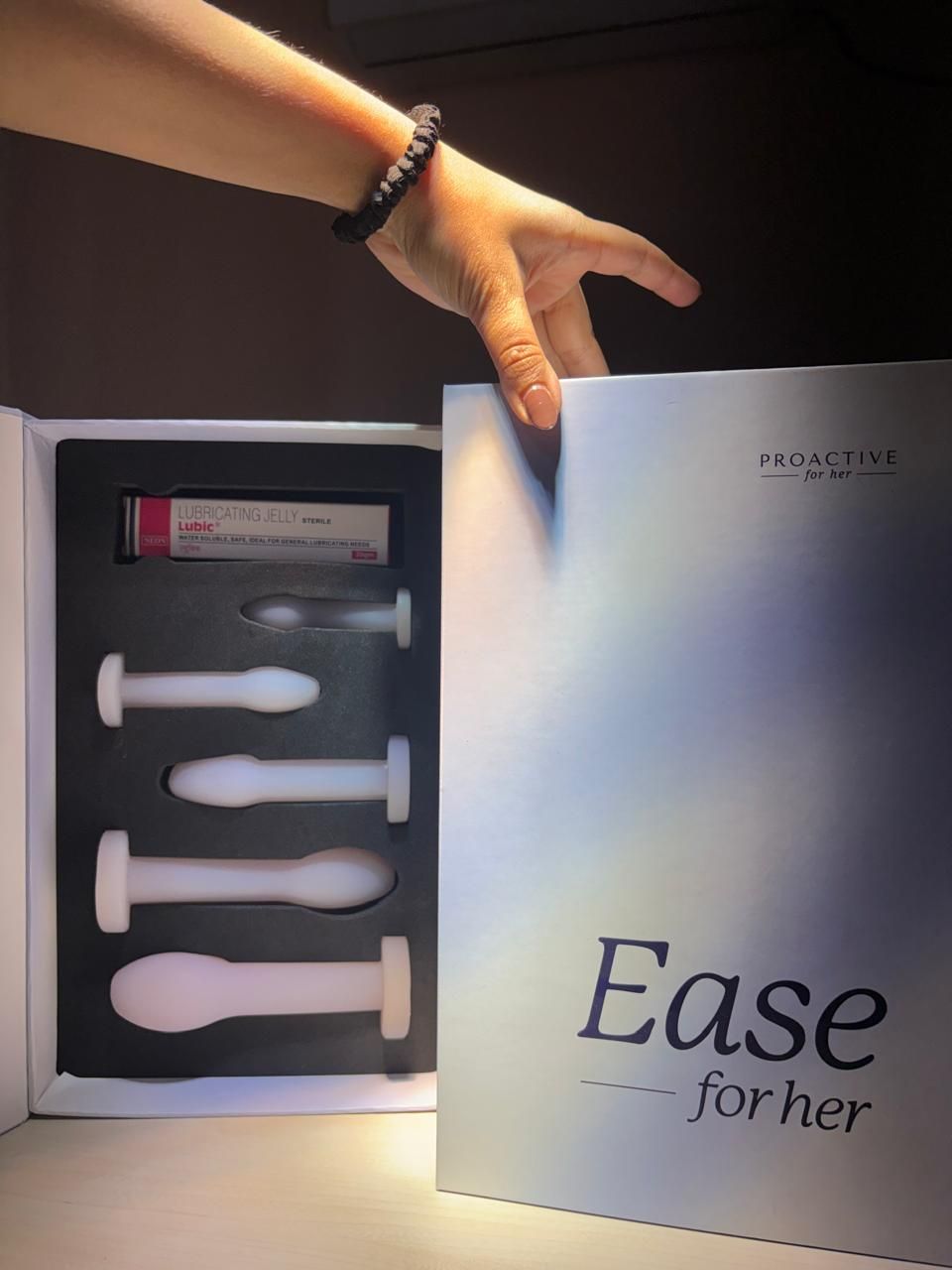
Vaginal dilators are smooth tools made from medical-grade plastic or silicone. They usually come in a set of graduated sizes, starting very small and increasing slowly.
They are not sex toys. They are not meant to replace intimacy or pleasure. They are also not quick fixes.
Many women at Proactive initially associate dilators with fear, shame or the feeling that sex has become overly medical. These reactions are common and valid. However, globally, dilators are a standard, evidence-based intervention for vaginismus and pelvic floor tightness.
Their purpose is not penetration itself. Their purpose is to help the body feel safe again.
How vaginal dilators work for vaginismus
Dilators work through gradual exposure. Instead of asking the body to suddenly tolerate penetration during sex, dilators introduce gentle, controlled sensations in a non-sexual, low-pressure setting.
This helps in several ways:
- Muscle desensitisation: The pelvic floor muscles learn that contact does not equal danger.
- Nervous system retraining: Fear-pain cycles begin to soften when the brain receives repeated signals of safety.
- Restoring confidence: Many women experience their first pain-free insertion during guided dilator work, not during penetrative sex.
At Proactive, this moment is often described as a turning point. It shows the body that pain is not inevitable.
Progress with dilators is not linear. Some days feel easier than others. This variability is normal and expected.
Benefits of using vaginal dilators
Reducing painful sex
By reducing involuntary muscle tightening, dilators can make penetration more comfortable over time. They address the root muscle response rather than pushing through pain.
Increasing comfort and confidence
From Proactive’s post-healing data, 91 percent of women reported a significant improvement in confidence. Over half also reported improved relationship satisfaction, largely because fear was no longer controlling intimacy.
Clinically, dilators help reduce muscle guarding and anticipatory fear. They are part of evidence-based care, not do-it-yourself experimentation.
Success is defined by comfort and safety, not how fast you move through sizes.
How to choose the right dilator
Choosing the right dilator matters more than choosing an expensive brand.
Size progression
Starting small is essential. Many women worsen fear by beginning with sizes that are too large. Smaller sizes allow the body to relax instead of brace.
Material safety
Medical-grade silicone is recommended. These materials are smooth, non-porous and easy to clean.
Guidance matters
Many women at Proactive had already purchased dilators online but did not know how or when to use them. Clinician guidance helps tailor progression to your body rather than a generic timeline.
There is no correct size to reach by a certain date. Healing does not follow a calendar.
How vaginal dilators are used: a high-level explanation
Dilator use should happen in a calm, private environment where you feel safe. Breathing and relaxation are as important as the tool itself. Gentle progression is key, and stopping at discomfort is encouraged.
Dilators are not meant to override pain signals. If discomfort appears, pausing is part of the process. Many women need as much emotional reassurance as physical guidance during this phase.
Physiotherapist-led protocols emphasise nervous system regulation alongside any physical work. Autonomy matters. Stopping is not failure. It is listening.
Emotional and psychological considerations
Dilator use can bring up anxiety, frustration or grief. Some women feel ashamed that they need help with something others seem to do effortlessly.
At Proactive, 35 percent of women experienced extreme emotional distress during penetration attempts before treatment. These emotions do not disappear overnight.
Vaginismus healing is a mind-body process. Emotional safety reduces muscle guarding. Support from therapists helps untangle fear, pressure and self-blame that often accompany dilator work.
Struggling emotionally does not mean dilators are not working. It means you are human.
When dilators alone are not enough
Dilators are most effective when combined with other forms of care.
- Pelvic floor therapy helps address muscle patterns and breathing.
- Emotional therapy addresses fear, shame and performance pressure.
- Partner involvement, when appropriate, helps rebuild trust and communication.
At Proactive, dilators are one part of an 8+ touchpoint program that integrates medical care, physiotherapy and therapy. This multidisciplinary approach consistently outperforms standalone advice.
You do not have to figure this out alone.
Why Proactive For Her
Proactive For Her runs India’s first and leading vaginismus program. Over 750 women have healed, with more than 2,000 diagnosed and over 50,000 women supported across services. Seventy-one percent of healed patients successfully used dilators as part of care.
With seven clinics in Bangalore and over five years of focused experience, Proactive offers doctor-led, multidisciplinary treatment. The founding team and clinicians include people with lived experience of vaginismus, shaping a care model built on empathy as much as evidence.
Our structured, supervised dilator protocols are grounded in global best practices and adapted for Indian women. Women choose Proactive for safety, consistency, emotional support and outcomes.
Vaginal dilators are not a measure of worth or success. They are simply a tool to help your body feel safe again. Healing is possible, and you deserve care that understands both the science and the fear.